Imagine a familiar situation for a German DeFi user. You connect a wallet to a lending protocol on Arbitrum, move to a decentralized exchange on Base, and then approve a token on Ethereum. The assets are yours, but the interface presents a series of contract calls, network changes, approvals, and fee decisions that are easy to misunderstand. A single confirmation may look routine while granting a broader permission than intended. This is the practical problem behind the search for a Rabby Wallet download or a Rabby Chrome extension: not simply storing tokens, but interpreting what a decentralized application is asking the wallet to sign.
Rabby is a non-custodial wallet developed by DeBank for Ethereum and other EVM-compatible networks. Its central design idea is to place more information between the dApp request and the user’s signature. The wallet combines transaction simulation, security warnings, multi-chain account management, and hardware-wallet support. That does not make DeFi risk-free. It changes the quality of the decision a user can make before authorizing an irreversible blockchain action.
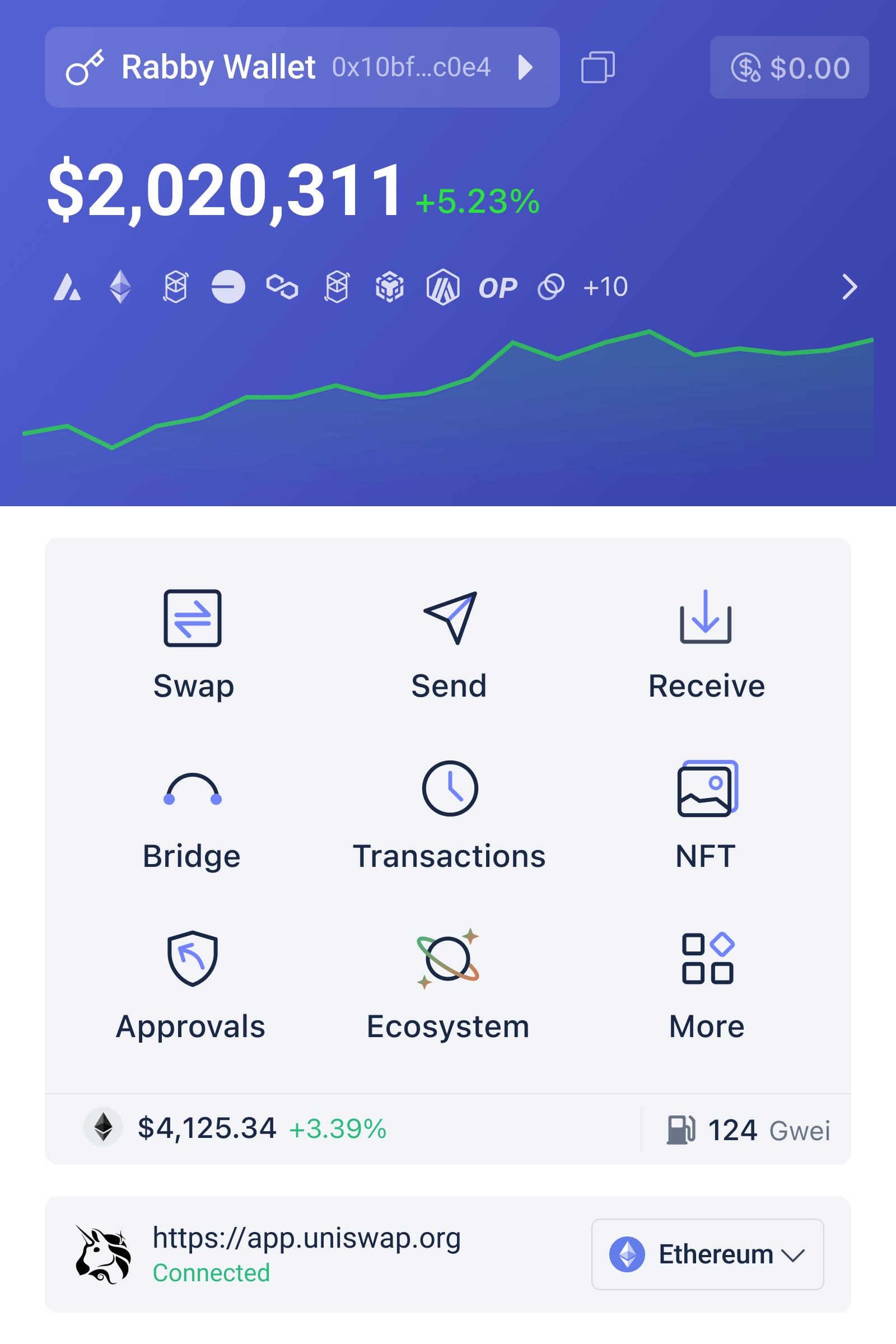
From wallet as key holder to wallet as transaction interpreter
The most useful way to understand Rabby is not as a stronger vault, but as an interpretation layer. In a conventional wallet workflow, a dApp constructs a transaction and the wallet displays a request for approval. The user may see a contract address, a method name, and a gas estimate, but these technical fields do not necessarily explain the economic result. Rabby’s transaction simulation attempts to translate the request into expected changes in token balances and positions before signing.
This distinction matters because blockchain transactions are usually deterministic only after several assumptions hold: the intended contract is genuine, the market price does not move too far, the quoted route remains available, and the transaction executes as expected. A simulation can reveal that a swap would send one asset and receive another, or that an approval would create a potentially broad spending permission. It is therefore a preview of consequences, not a guarantee of safety.
Rabby also includes a security engine that checks contracts and addresses for signals associated with phishing, known hacks, and unlimited token approvals. These warnings are useful because many attacks exploit attention rather than cryptography. A user may correctly protect a seed phrase yet still sign a malicious approval. The scanner addresses that behavioral bottleneck by making suspicious patterns more visible at the moment when they matter.
There is, however, an important boundary. Security scanners depend on available information, detection logic, and the quality of the underlying analysis. A new or previously unclassified contract may not produce a warning, while a warning may require contextual judgment rather than automatic rejection. Users should treat the scanner as a risk filter and an additional review step, not as an insurance policy.
Why the Rabby Chrome extension is relevant to multi-chain users
Rabby is primarily available as a browser extension for Chrome, Brave, and Edge, with desktop applications for Windows and macOS and mobile applications for iOS and Android. For many users, installing the extension is the practical entry point because DeFi activity still takes place largely in a browser. The extension can recognize the network required by a connected dApp and switch to it automatically, reducing one common source of confusion: signing on the wrong chain or manually configuring networks under pressure.
The wallet supports more than 140 EVM-compatible networks, including Ethereum, Polygon, Arbitrum, Optimism, Avalanche, Base, and BNB Chain. This breadth is valuable, but it creates a trade-off that is easy to overlook. More networks mean more opportunities and often lower fees, yet they also increase operational complexity. Similar token symbols may exist on different chains, bridge routes can introduce separate contract risks, and liquidity conditions vary considerably. A smooth interface can reduce friction without eliminating the need to verify the chain and asset.
For readers evaluating where to rabby wallet herunterladen, the safest principle is to use the project’s recognized distribution channels and verify that the extension publisher and permissions are consistent with the official product. Search results and third-party download pages are a common phishing surface. The technical security of a wallet cannot compensate for installing an imitation extension that captures credentials or redirects transactions.
Bridges, swaps, and fee abstraction
Rabby integrates swap functionality that can scan decentralized-exchange routes such as Uniswap and 1inch, with the aim of finding competitive prices while limiting slippage. It also integrates bridging infrastructure such as LI.FI, allowing users to move assets between networks from within the wallet interface. These features make the wallet more than a passive signing tool: it becomes an execution workspace.
That convenience compresses several independent risks into one screen. A swap involves price impact, liquidity, slippage, and contract execution. A bridge adds another protocol layer, possible delays, route selection, and chain-specific failure modes. The interface may simplify the workflow, but the economic and technical dependencies remain. Advanced users should inspect the route, asset, destination chain, and approval scope rather than evaluating only the final quoted amount.
The Gas Account feature addresses a different practical obstacle. It allows network fees to be paid across supported contexts with stablecoins such as USDC, even when the user lacks the native token required by a particular chain. This can reduce the awkward situation in which funds are present but unusable because a small amount of native gas is missing. The limitation is conceptual: fee abstraction changes how gas is funded, not the cost or risk of the underlying transaction. A convenient payment method should not be confused with cheaper execution or safer protocol design.
Self-custody, backend independence, and hardware signing
Rabby follows a non-custodial model. Private keys are stored locally on the user’s device and are not sent to Rabby’s servers. The wallet does not itself alter or create the user’s intended transactions; its core signing functions can remain available even if Rabby’s backend services are unavailable. This separation is important because it clarifies what the provider controls and what the user controls.
Self-custody, though, transfers responsibility rather than removing it. A compromised computer, malicious browser extension, exposed seed phrase, or careless signature can still result in loss. The local-storage model protects against a wallet provider holding the keys, but it does not protect every endpoint through which the user interacts with DeFi. For larger balances, connecting Rabby to a Ledger, Trezor, or OneKey hardware wallet creates an additional signing boundary: the private key remains on the device, while Rabby supplies transaction context and interface support.
The open-source architecture, released under the MIT license, provides another form of accountability because the code can be examined by the community. Open source improves inspectability, but inspection is not identical to a complete security audit, and users cannot assume that every future release has been reviewed equally. A sensible security model combines verified software, a separated hardware signer where appropriate, small test transactions, and deliberate approval management.
A practical decision framework for German DeFi users
Before using any wallet, ask three separate questions. First, can I identify the asset, network, recipient, and contract involved? Second, does the transaction preview match the economic action I intended? Third, what remains outside the wallet’s ability to verify? The third question is often the most valuable. A wallet can show expected balance changes, but it cannot decide whether a yield strategy is economically sound, whether a bridge is appropriate for a given exposure, or whether a protocol’s governance incentives are acceptable.
For everyday use, Rabby is most compelling when the main problem is transaction comprehension across several EVM chains. Its simulation and warnings can reduce the gap between technical calldata and human intent. For a beginner who wants a simple place to hold funds, the range of networks and features may instead feel busy. For a high-value account, hardware signing remains prudent even when the browser interface is clear. The right evaluation therefore depends less on brand preference than on the user’s exposure, frequency of interaction, and ability to review contract permissions.
Rabby Points, earned through actions such as swaps, gas top-ups, or referrals, may add a loyalty layer to the product. Such incentives should be assessed separately from security. Rewards can encourage engagement, but increased activity also increases the number of signatures and protocol interactions. The economically rational choice is not to maximize wallet activity; it is to use only the functions that solve a real operational problem.
What to watch next
The recent Chrome Web Store description continues to position Rabby as an open-source Ethereum and EVM wallet designed for a smooth multi-chain DeFi experience with protection features. The meaningful question is not whether interfaces become more polished, but whether they help users distinguish between a clear transaction and a trustworthy transaction. If simulations become more informative and warnings become more context-sensitive, wallets could evolve into practical risk-analysis tools. That outcome would depend on reliable data, transparent detection limits, and users who still treat the final signature as a serious authorization.
Frequently asked questions
Is Rabby Wallet a custodial service?
No. Rabby is designed as a non-custodial wallet. Private keys are stored locally on the user’s device rather than being held by Rabby. This preserves user control, but also means that seed-phrase protection, device security, and signature discipline remain the user’s responsibility.
Does transaction simulation guarantee that a DeFi transaction is safe?
No. Simulation shows expected effects, such as changes in token balances, before signing. It can expose discrepancies and suspicious approvals, but it cannot guarantee that a contract is honest, that market conditions will remain stable, or that every new attack pattern will be detected.
Why use Rabby with a hardware wallet?
Rabby can provide detailed transaction context while a compatible hardware wallet keeps the private key separated from the computer. This combination does not remove protocol risk, but it strengthens the boundary around the signing key and is particularly relevant for larger balances.
The central lesson is straightforward: a multi-chain wallet should be judged not only by how many networks it supports, but by how well it helps the user understand a signature. Rabby’s strongest contribution is the attempt to turn an opaque approval into an interpretable decision. Its limits are equally important. No extension can replace verified downloads, careful permission management, hardware protection where appropriate, or independent judgment about the protocols being used.